
So, how does your organisation compare?
Most HR teams are currently building the structures and processes they need to help them make stronger, data-informed decisions. I’m guessing you’re on that journey too?
It can be really hard to know what to build if you don’t have anything to show you what it ‘should’ be like when data is working for your organisation.
Consider this document to be your architect’s plans, your blueprints, your structural drawings. Everything you need to understand what the end goal is for your organisation’s size.
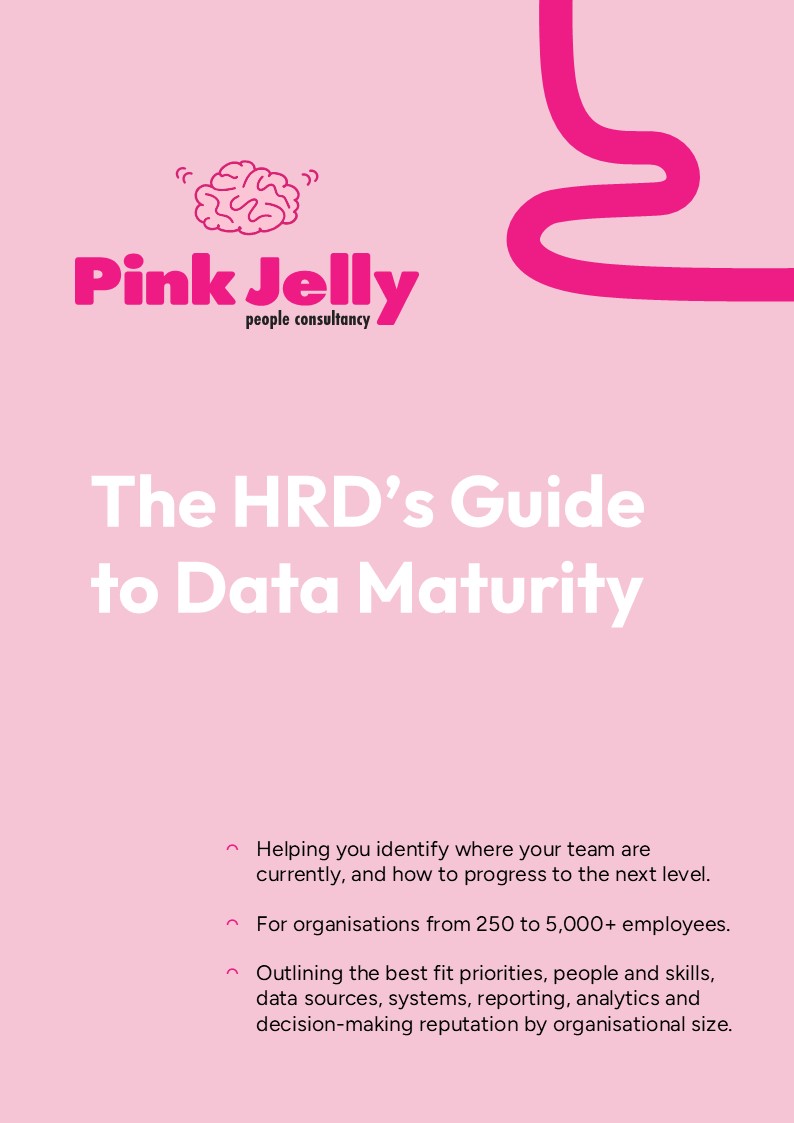
Broken down into 4 organisation sizes, the guide will show you the ideal setup for organisations of less than 250 employees, 250-1k employees, 1-5k employees and 5k+ employees across areas like people and skills, systems, reporting, and analytics.
Contained in the guide:
- How to use the guide – covering reviewing your current setup and identifying gaps
- The cost of being underdeveloped – why investing in data structures and processes is a necessity today
- 7-8 pages detailing the ideal priorities, people and skills,
data sources, systems, reporting, analytics and
decision-making reputation for each organisation size - Action planning – we all know that just reading the guide won’t fix anything, so I’ve included a page to help you map out how you will close the gaps
What can you expect at each stage?
Less than 250 employees
In a constantly changing organisation like yours, most of your time will be spent ‘keeping up’ with the organisation. Your focus will be on collecting and process-ising data so that you can start to make use of it, now or in the future.
250 - 1,000 employees
Data-related activities are no longer reactive. You’re starting to build the right processes so that the HR team and the business can rely on certain data being available to them. Reporting is more manual than it could be, but working with data is getting easier, enabling you to expand what your team offers.
1,000 - 5,000 employees
By now, the team should be working more proactively with the business, offering them more analytics, and less simple reporting and basic statistics. Most data flows automatically between systems, resulting in mostly automated, self-service reporting. Your team is beginning to be seen as a credible, data-led function.
5,000+ employees
At this point, you should have a robust people analytics structure, ensuring the business has the answers to most of its question. Therefore, what happens next is entirely dependent on how far your organisation wants to run with HR data. It could be the source of your organisation’s competitive advantage, or just an enabler of other things.
Download now...
Once you submit this form, you’ll be redirected to download The HRD’s Guide to Data Maturity. As a follow up, I’ll then send you a couple of emails that I hope will help you use the guide and think about your own organisation’s data maturity. After those are finished, you’ll be transferred onto my regular newsletter list. The newsletter aims to be thought-provoking, insightful and useful, no rubbish. Fortnightly emails, straight from my brain to yours.
If you find that you need to close some gaps in your team, I’d love to talk it through with you. There are a number of ways that I can help. You’ll find more details about each offering by clicking the buttons.